What Is PoE? Power over Ethernet Explained
If a security camera listing mentions PoE, it is talking about Power over Ethernet. PoE allows one Ethernet cable to carry both network data and electrical power to a device such as an IP camera, access point, or intercom. For camera systems, this matters because it can reduce wiring complexity and make the system more stable than a purely wireless setup.
At HB Tech Pros, we like PoE because it connects directly to the practical side of security camera performance. A camera is not only about resolution or app features. A camera also has to stay powered, stay connected, record reliably, and be mounted where the view actually protects the property.
What PoE Means in Simple Terms
PoE means the same Cat5e or Cat6 Ethernet cable can carry power and data at the same time. Without PoE, a camera may need one connection for power and another connection for network data. With PoE, the installation is cleaner because the camera can connect back to a PoE switch or PoE NVR using one cable.
Why Professional Installers Often Prefer PoE
PoE is popular in professional security systems because wired connections are more predictable than wireless connections. Wi-Fi cameras can work very well, but wireless performance depends on signal strength, distance, walls, interference, router location, and network traffic. A properly installed PoE cable removes many of those variables.
- One cable handles both power and data.
- Wired communication is usually more stable than Wi-Fi for continuous video.
- PoE is well suited for 24/7 recording to an NVR.
- PoE makes it easier to place cameras in critical locations where reliability matters.
- PoE systems are easier to expand in a planned installation.
PoE Standards: PoE, PoE+, and PoE++
Not every PoE port delivers the same amount of power. The common standards are IEEE 802.3af, IEEE 802.3at, and IEEE 802.3bt. A simple rule is that basic fixed cameras often use standard PoE, while larger cameras, PTZ cameras, and higher-power equipment may require PoE+ or PoE++.
| Standard | Common Name | Typical Power Class | Common Uses |
|---|---|---|---|
| IEEE 802.3af | PoE | Up to about 15.4W from the power source | Basic IP cameras, phones, small devices |
| IEEE 802.3at | PoE+ | Up to about 30W from the power source | Higher-power cameras, PTZ cameras, access points |
| IEEE 802.3bt | PoE++ | Higher power classes, including Type 3 and Type 4 | Advanced cameras, lighting, displays, high-power equipment |
PoE vs. Wi-Fi Cameras
PoE is not automatically the right answer for every homeowner. Wi-Fi cameras can be easier for renters, apartments, temporary installs, and single-camera setups. PoE makes more sense when the installation is permanent, reliability matters, or multiple cameras need to record continuously.
| Question | PoE Camera | Wi-Fi Camera |
|---|---|---|
| Best for | Permanent systems, businesses, critical coverage | Quick DIY installs, renters, easy locations |
| Power | Power through Ethernet cable | Outlet, battery, or solar accessory |
| Video reliability | Usually high because the connection is wired | Depends on Wi-Fi quality and distance |
| Installation effort | More planning and cable routing | Usually easier at first |
| Long-term maintenance | Low once installed correctly | Can include signal, battery, or Wi-Fi troubleshooting |
Common PoE Mistakes
- Buying a camera that needs PoE+ and connecting it to a standard PoE-only switch.
- Ignoring the total PoE power budget of the switch.
- Using poor-quality or damaged cable and then blaming the camera.
- Running cable without thinking about water entry, cable protection, and service access.
- Mounting the camera where the angle is wide but identification detail is poor.
What Is the Maximum PoE Cable Distance?
The standard PoE cable distance limit is 100 meters (328 feet), the same limit that applies to regular Ethernet. This comes from the Ethernet cabling standard itself, not from the power side of PoE. If a camera needs to sit farther from the switch than that, a PoE extender can regenerate the signal and push the usable distance out further, sometimes 200 meters or more depending on the extender, though data speed can drop on longer extended runs.
PoE Injector vs. PoE Switch
A PoE injector adds power to a single Ethernet cable so one PoE device, like a camera, can run off a regular non-PoE switch or router. It's a simple way to add one PoE camera without replacing your existing network switch. A PoE switch has PoE built into multiple ports at once, which makes more sense once you have several PoE cameras or devices to power. Neither one extends cable distance beyond the standard 100 meter limit, that requires a dedicated PoE extender instead.
For permanent security camera systems, we consider PoE the most reliable and professional choice. Wi-Fi cameras still have a place, especially for quick installs, renters, and easy indoor locations. But when the goal is dependable coverage, clean recording, and fewer connection problems, PoE is usually the stronger foundation.
FAQ
What is the maximum PoE cable distance?
The standard limit is 100 meters (328 feet), the same as regular Ethernet. A PoE extender can push this further if needed, though data speed may drop on longer extended runs.
What is the difference between a PoE injector and a PoE switch?
A PoE injector adds power to a single Ethernet cable for one device, useful when you have a non-PoE switch. A PoE switch has PoE built into multiple ports, which makes more sense for several cameras or devices at once.
Do PoE cameras need internet?
PoE cameras do not always need internet to record locally to an NVR. Internet is usually needed for remote viewing through an app, cloud access, or notifications outside the local network.
Can PoE cameras work without an NVR?
Yes, some PoE cameras can work with a PoE switch and record to a microSD card, NAS, computer software, or cloud service. However, an NVR is often preferred when continuous local recording is important.
Is PoE better than Wi-Fi for security cameras?
PoE is usually better for permanent installations where reliability and continuous recording matter. Wi-Fi is usually easier for quick installs, renters, and locations where wiring is not practical.
What cable do PoE cameras use?
Most PoE camera installations use Cat5e or Cat6 Ethernet cable. For outdoor runs, use cable rated for the environment and protect the cable from water, sunlight, and physical damage.
Can one Ethernet cable power multiple cameras?
A single Ethernet cable normally powers one camera at the end of that cable. Multiple cameras usually connect to multiple PoE switch ports or NVR PoE ports.
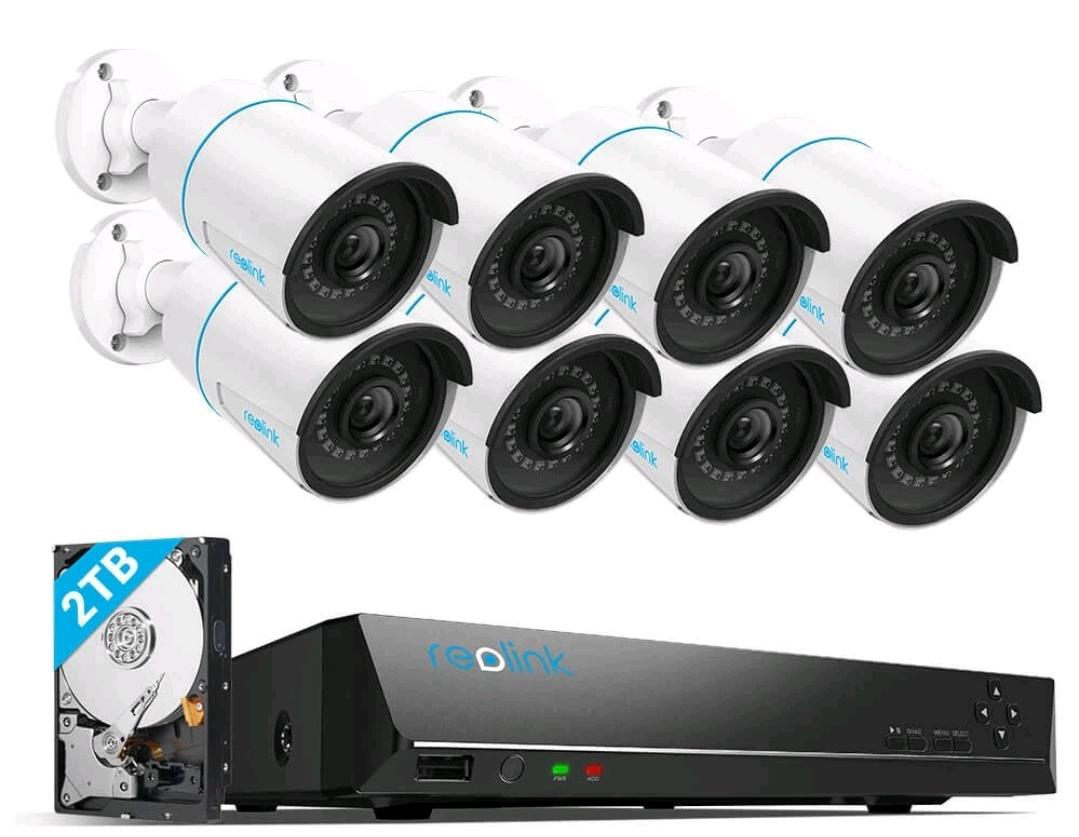 Reolink DIY 5MP PoE System