What Is a Watt-Hour? Battery Runtime Explained
A watt-hour, written as Wh, is a unit of energy. It helps explain how much energy a battery can store or how much energy a device uses over time. This number matters when comparing portable power stations, battery backups, solar generators, and even small power banks.
At HB Tech Pros, we consider watt-hours one of the most important numbers in backup power. Many buyers focus on marketing names, but runtime depends on energy capacity, load size, efficiency losses, and how the equipment is used.
Watts vs. Watt-Hours
- Watts (W) measure power: how fast a device uses energy at a moment in time.
- Watt-hours (Wh) measure energy: how much energy is used or stored over time.
If a device uses 100 watts for 2 hours, it uses 200 watt-hours of energy. If a portable power station stores 1000Wh, that means it has a theoretical energy capacity of 1000 watt-hours before real-world losses.
The Runtime Formula
For example, if a power station has 1000Wh of capacity and the connected device uses 100W, the simple estimate is 1000Wh divided by 100W, or about 10 hours before losses.
Actual runtime is usually lower because of inverter losses, battery management limits, startup surge, temperature, and the fact that some devices cycle on and off.
Example Runtime Table
| Device | Approx. Load | 1000Wh Simple Estimate | Engineer’s Note |
|---|---|---|---|
| Wi-Fi router | 10W | 100 hours | Good backup load, internet service may still depend on provider equipment. |
| Laptop | 60W | 16.6 hours | Actual runtime depends on charger behavior and battery state. |
| Small camera/NVR setup | 40W | 25 hours | Good example of why watt-hours help security planning. |
| CPAP machine | 40W | 25 hours | Humidifier or heated tube can increase load significantly. |
| Refrigerator | 100W average | 10 hours | Startup surge and cycling make real results vary. |
| Space heater | 1500W | Less than 1 hour | Resistive heat drains batteries quickly and is usually not a good backup load. |
Why Marketing Can Be Confusing
Portable power products often advertise large numbers, but not all numbers mean the same thing. Capacity in Wh tells how much energy is stored. Output in W tells how much power the station can deliver at one time. Solar input in W tells how quickly the station can recharge under good sunlight conditions.
- Capacity: how much energy is stored.
- Output: how large of a load the unit can power.
- Solar input: how fast the unit can recharge from panels.
- Surge rating: how much short burst power the unit can handle for motor startup.
Common Buying Mistakes
- Buying a small camping power station and expecting it to run major home loads.
- Ignoring startup surge for refrigerators, pumps, and tools.
- Confusing watts with watt-hours.
- Assuming solar panels always produce the rated wattage.
- Forgetting to include small critical loads like router, modem, camera system, and phone charging.
Before buying a power station, we recommend listing the loads that actually matter during an outage. Then estimate watts, runtime hours, and total watt-hours. For cameras, routers, laptops, and small electronics, a mid-size power station can be useful. For refrigerators, sump pumps, or several rooms, the system needs more capacity and output. The watt-hour number is the starting point for that decision. Our power station sizing calculator walks through this math for you, check off your actual devices and it works out the watt-hours and recommends a real capacity to buy.
FAQ
Is a higher watt-hour number better?
A higher watt-hour number means more stored energy, but it is not the only factor. Output rating, surge rating, battery chemistry, recharge speed, and warranty also matter.
How long will a 1000Wh power station last?
A simple estimate is 1000Wh divided by the device load in watts. A 100W load estimates about 10 hours before real-world losses. A 500W load estimates about 2 hours before losses.
What is the difference between watts and watt-hours?
Watts measure how fast power is being used. Watt-hours measure how much energy is used or stored over time.
Can a 1000Wh power station run a refrigerator?
It may run some refrigerators for a limited time, but real runtime depends on average power, startup surge, temperature, door openings, and inverter efficiency.
Why do actual runtimes differ from calculations?
Actual runtime differs because of inverter losses, battery reserve limits, startup surge, device cycling, temperature, and rated capacity assumptions.
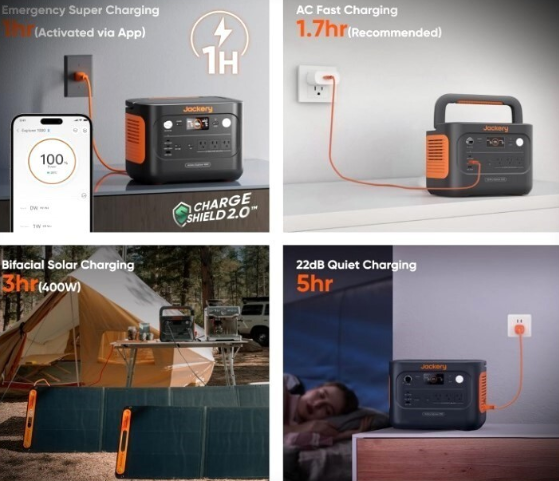 Jackery, EcoFlow, and BLUETTI